

When should you build your brand?
By Sandeep Singh Sura, Brand Strategy & Creative Direction · Triple Think
[Approx; 5 minute read]
Build your brand last.
That sounds backwards, because the brand is the part you can see. The name, the colours, the look. So when a founder pictures their idea becoming real, they picture the brand. It feels like the thing that makes the business exist.
But a brand sits on top of something. Underneath it is the actual business: the problem you solve, who needs it, how it makes money. If that hasn't been decided, there's nothing for the brand to stand on. So the honest answer to "when should I build my brand" is: once the business beneath it is built, and not a moment before.
So the honest answer is: build the business beneath it first, and the brand last. Get that order wrong and you pay for it, which is what this is really about: what a brand actually is, and why it has to come last.
…
In this article:
The order you build in
Why the brand comes last
Why founders reach for it first
A real example
How to tell which layer you're on
What it costs to build too early
The takeaway
FAQs
…
The order you build in
A business sits on layers. They only hold when you build them bottom to top.
Business: The real problem you solve.
Customer: Who actually needs it.
Model: How it pays for itself.
Product: The thing that solves the problem.
Brand: The meaning that forms on top.
Each layer rests on the one below it. You earn the next layer only when the one beneath it has a real answer, not a guess. The brand is layer five, which is why it comes last.
…
Why the brand comes last
A brand is the meaning people attach to a business. It's far more than a name and a logo. Those are inputs to it, the visible signals, but they are not the thing itself. That meaning only forms once there's a real business for it to form around. A clear problem, a customer who needs it, a way to make money. Try to create the brand before any of that is decided and you are not building a brand. You are decorating a guess. It might look finished, but there's nothing underneath holding it up.
…
Why founders reach for it first
If the brand comes last, why do so many founders start there? Because the brand is the part that feels like progress. Watching a logo come together is exciting and visible. It makes the business feel like it's happening. The questions underneath are slower and harder, and they are easy to put off.
So we skip them and reach for the visible bit.
There's a quiet danger in that. A good designer will make even a half-formed idea look certain. Polish doesn't prove a business works. It just makes it look like it does.
…
A real example
A founder came to me ready to go. He had a product. He had a name. He had a budget set aside, and he wanted the designs, fast.
"I've got the product and the name. I just need the designs now."
But that's not where I start. Before any creative work, on every project, I run the same sequence. I read the situation, I break it down to the real choices, and only then do I build. With him, the reading is what changed everything.
So we spent two weeks on a single question: what is this business?
The product was real. What sat under it had not been built yet. Who it was for, how it would make money once the true cost of making and delivering it was counted, what the business even was beyond the product. All of it still open. He had a product looking for a business. So we built one. Here's what that took:
Each founder alone: He and his co-founder answered the same hard questions separately. Done apart on purpose, because it shows where two partners quietly disagree.
A market study: Who else is out there, what they charge, who they really serve. We looked properly, instead of guessing.
Outside expert opinion: I took the thinking to people who have built businesses themselves. They see in five minutes what a plan takes weeks to argue.
The strategy workshop: We pulled apart other brands first, then turned the same lens on his. One customer, one moment, one product, and the customers he would let go of.
Proof before spending: We put the product in real hands for a month. Did they finish it, could they feel it, would they pay for it.
Then the shift: He came in with a product, a name, and a brief for the look, chasing every customer and every channel at once. He left with one customer, one moment to own, a way to prove it before spending, and an honest number for what the first year really costs.
The designs did not disappear. They moved to where they belong. Last.

…
How to tell which layer you're on
You can run this on your own idea. Walk up the layers, and under each, answer the honest version of the question:
Business: Is the problem real, and worth paying to fix?
Customer: Who needs it most? Can you name them without saying "everyone"?
Model: Does the money actually cover what it costs to deliver?
Product: Is this the simplest version that solves the problem?
Brand: What should people feel about it?
There's one quick tell. Watch your product. A clear business keeps it small and focused. A fuzzy one makes it grow, feature after feature, hoping one lands. If you can't stop adding to it, the business underneath probably isn't decided yet.
…
A simple way to test this on your own idea. Walk up the layers, and under each, ask the honest version of the question:
Business: is the problem real, and worth paying to fix?
Customer: who needs it most? Can you name them, without saying "everyone"?
Model: does the money actually cover what it costs to deliver?
Product: is this the simplest version that solves the problem?
Brand: What should it mean to the customer?
There's one quick tell. Watch your product. A clear business keeps it small and focused. A fuzzy one makes it grow, feature after feature, hoping one lands. If you can't stop adding to it, the business underneath probably isn't decided yet.
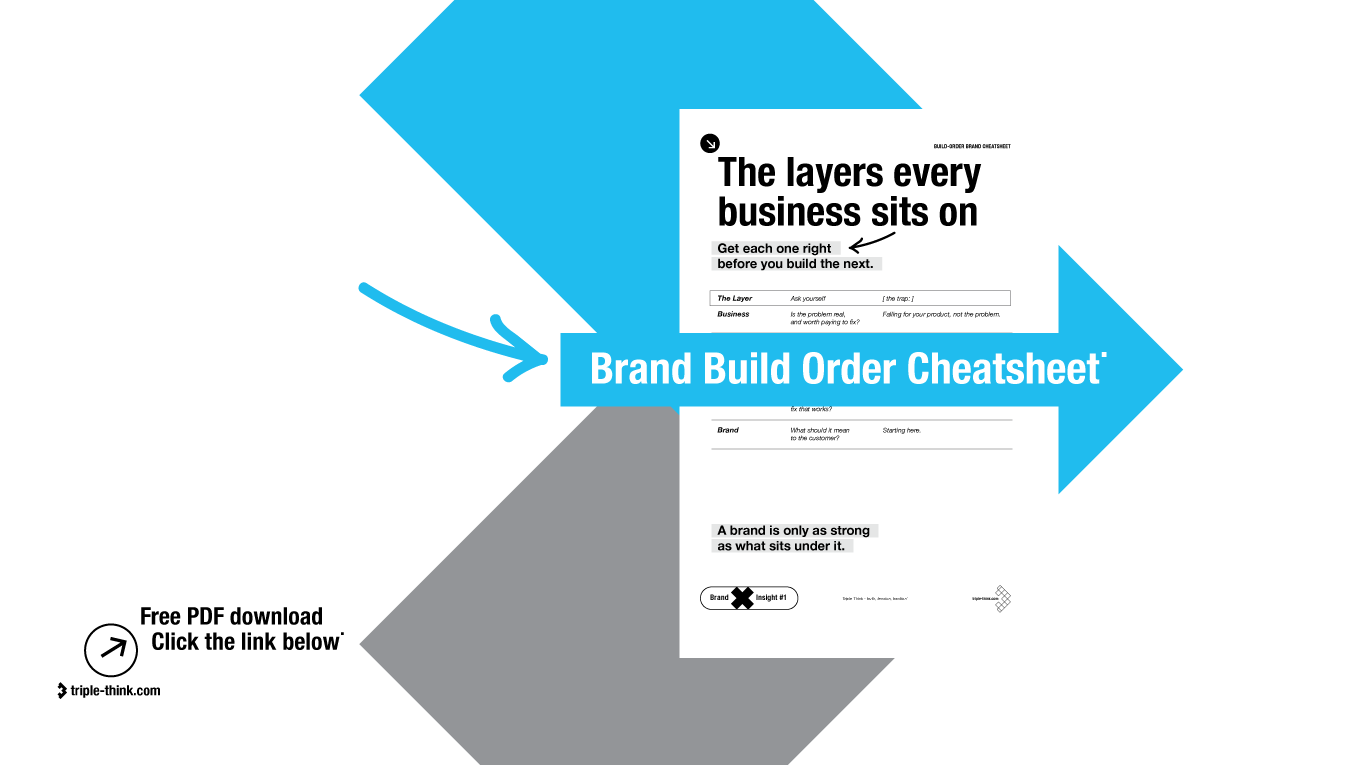
Click here > Download Free PDF - Brand Build Order Cheatsheet
…
What it costs to build too early
Building the brand early feels safe, but it's the most expensive order to build in. You pay twice. Once to create a brand around a business that isn't settled, and again to redo it when the business finally is. And while you're paying, the polish is hiding the gaps you should have been fixing.
Get the order right and the opposite happens. Once you can say what the business is, the clarity does the creative work for you. The designs almost brief themselves. The thinking is the work. The redo is the waste.
…
The takeaway
Build your brand last. It's the most visible layer, so it's the one founders reach for first, but it can only mean something once there's a business beneath it. The instinct is to make things, because making feels like momentum. The discipline is knowing what shouldn't be made yet.
…
FAQs
When should a startup invest in branding?
Once the business underneath is decided, not before. If you can name your customer without saying "everyone," and you know the money covers what it costs to deliver, you have something for a brand to stand on. Before that, you'd be branding a guess, and you'll likely pay to redo it.
Is a brand the same as a logo?
No. A name and a logo are things you make. A brand is something you earn. The logo is one visible input; the brand is the whole meaning people attach to your business once it's real. You can have a beautiful logo and no brand, because there's nothing underneath for it to mean.
What happens if you build your brand too early?
Two things, both costly. You build a brand around a business that then changes, so you pay to redo it. And a polished brand makes a half-formed business look finished, so you stop asking the questions that would have saved you. Deciding the business first is slower, but it's the work that prevents the waste.
Click here > Subscribe to the Blank Canvas Newsletter on linkedIn
…
Sandeep Singh Sura is a brand strategist and creative director with 25+ years across DDB, Ogilvy and BBDO, with accounts including Unilever, Coca-Cola, EABL, Britam and Kenya Tourism Board. Triple Think - truth, tension, traction˙ - advises founders and institutions on brand strategy, positioning, and creative direction across Africa. Work with Triple Think > click here
Thank you for reading! I’d love to hear your questions or thoughts - leave a comment below!