

Meet the BrandLord
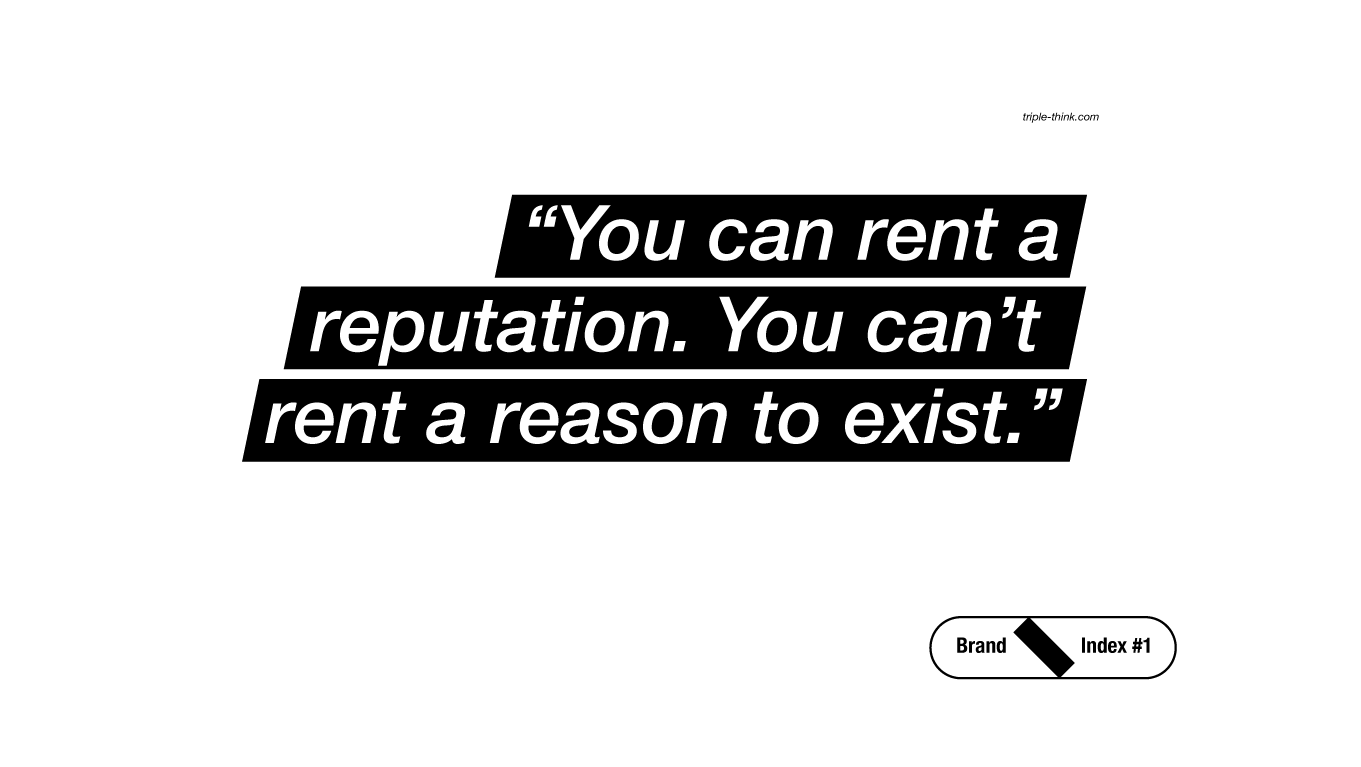
A brand that runs on someone else's name.
By Sandeep Singh Sura, Brand Strategy & Creative Direction · Triple Think
Approximate read-time: 6-8 minutes.
Brand Index. This is where I keep track of what I see across the brands I work with, the patterns that show up again and again. Here is one of them #1.
Years ago, when I first went out on my own, someone gave me a challenge. Describe your new consultancy, he said. But you can't mention a single place you've ever worked.
So, no DDB. No Ogilvy. No BBDO. None of the twenty-five years.
Hmmmmm... I struggled. Quite a bit, actually. And I'll be honest, I was a little annoyed. That list was my whole pitch. It took me a while to get what he was really asking. Did I have a business of my own, or just a good list of names to stand behind?
I've thought about it a lot since, because I keep meeting the same question inside other people's companies. A business that looks strong from the outside and owns almost none of that strength. Long relationships. A wall of logos in reception, most of them belonging to someone else. It sells another company's product, carries another company's name, and spends years quietly making someone else famous.
So I gave it a name. The BrandLord. A brand that runs on someone else's name.
In this article:
How it starts
What it costs you
How to catch it early
FAQs
…
…
How it starts
Before anyone feels accused, let me say the obvious thing people somehow miss. Borrowing is not the crime. It is how almost everything starts. You stand on a trusted name because building your own takes ten years you do not have, and a customer will say yes to a name they already know on a Tuesday afternoon without thinking too hard about it. The corner duka that stocks Coca-Cola is not doing anything wrong. It is borrowing a hundred years of somebody else's trust, and it works.
The trouble is never the borrowing. The trouble is forgetting to do anything else.
Borrowing is meant to be the first move, not the whole game. You use a known name to get in the door. Then, while you are inside, you build something of your own. A skill. A way of working. A reason people would still call you if that famous name disappeared overnight. The problem starts when a business skips that middle part. It gets comfortable standing under someone else's umbrella, and never notices the rain stopped years ago.
Picture it plainly. Company X starts selling Company Y's products. In year one it is grateful for the line. By year three it is the best reseller in the region and proud of it. By year four that pride has quietly turned into a feeling of ownership. Our market. Our customers. Our name. Then one ordinary morning in year six, Company Y opens its own shop down the road, calls the customers it always really owned, and Company X finds out that six years of hard work built a business for somebody else. It was never their market. They were just the ones keeping it warm.
The exclusive deal that felt like protection was really just a rental agreement, and the landlord can end it on any ordinary morning, while you are still having your tea.
…
What it costs you
Here is the one idea worth taking from all of this.
What you actually own is whatever is still worth something after you take away the thing you depend on.
Take away the supplier. Take away the partner, or the famous name on the door. Whatever a customer would still happily pay you for, that is the part that is truly yours. For a lot of businesses, you do that little test in your head and what is left is an awkward silence.
And here is the part people get wrong in the other direction, which matters most of all. The thing that is yours does not have to be a product. You do not need a factory. You need one thing that cannot be taken away in a single phone call. It might be something you understand that nobody else does. It might be the relationship with the customer that the supplier never sees. It might be how you fit it, fix it, or deliver it. The speed. The service. The way you do things. The information you sit on. A group of people who would follow you even to a worse product, simply because they trust you. None of that leaves when the supplier does.
And yes, someone always points to the big companies that make almost nothing themselves and still seem to own everything. But look a little closer. Every one of them owns the part that really counts. The habit. The trust. The reason people keep coming back. They let someone else handle the product, and they built the loyalty. That is the whole difference.
…
How to catch it early
Now the tricky part, and it is almost touching. When a business like this feels the ground shifting, it rarely sits down and builds. It borrows harder. More partnerships. More badges on the wall. A bigger name to stand next to. It feels like getting stronger. It is the opposite. It is like a man who feels the branch cracking under him and decides the answer is to grab three more branches from the same dying tree. The more he holds on, the harder he falls.
I once asked a founder a simple thing. Tell me, in one sentence, why a customer picks you over anyone else. He gave me a lovely answer. Every word of it was about the brand he sells. So I asked him to say it again, but this time without mentioning that brand. The sentence got very short.
That silence is the whole problem. The first instinct, once it lands, is to reach for something that looks impressive. A new logo. A bigger office in a smarter part of town. A slick video with drone shots of a building they rent. None of it changes what is left when the borrowing stops. Looking solid and being solid were never the same thing.
If you want to catch this early, in your own business or one you are helping, you do not need a big audit. You need four honest questions.
• Take the borrowed names off the wall. What is the business still known for?
• What does it own that a supplier could take away with one phone call?
• If it put its prices up tomorrow, would anyone stay?
• Is the money going into looking impressive, or into owning something real?
If the answers come back thin, the borrowing has run its course.
None of this is a lecture against borrowing. Borrowing is how nearly everything good begins, including, if we are honest, most of us. It only turns dangerous the day a business mixes up standing next to strength with actually having it. So borrow. Borrow without shame. Just do not forget to build the thing they can never take back.
…
Things I wonder about
Not answers. Just things worth thinking about.
A global name lent to a local firm. What really gets borrowed, and what gets lost? The credibility comes across, and some of the network with it. But the culture rarely makes the trip, and the real skill almost never transfers the way the letterhead promised. And the local touch, the very reason people valued the firm, slowly fades behind the borrowed name. When the door opens, the real question is what walks through it, and what gets left outside.
The person who introduces themselves by where they used to work. Ten years at a famous company, worn like a badge. It opens doors for a long time. But there is always a morning when where they were stops mattering, and what they have done since has to carry them.
One entry in my index. I am working on the next one.
…
Oh! And that challenge from years ago still sits with me. Turns out he wasn't taking my story away. He was asking me to finally write my own. (And yes, you're about to see a list of famous agencies under my name. Like I said, borrowing is never the problem. Forgetting to build your own is.)
…
FAQs
How can a distributor or reseller build its own brand?
Stop trying to win on the product you do not control, and start owning the things you can. The relationship with the customer. The speed. The service. The know-how. The trust. You can sell someone else's product for years and still build something that is entirely yours underneath it. The test is simple. If the supplier walked away tomorrow, would people still come to you? Whatever makes them say yes is your real brand.
What happens when a supplier starts selling directly to customers?
It is one of the most common shocks in distribution, and it is rarely sudden. For years the supplier is happy to let you do the selling. Then one morning they open their own channel and call the customers they always technically owned. The businesses that survive it are the ones that saw it coming and built their own reason to be chosen long before the supplier ever needed them less. By the time it happens, it is usually too late to start.
How do you stop competing on price?
You compete on price when price is the only thing separating you from everyone else, which usually means you are selling the same thing they are. The way out is to own something that cannot be copied or discounted. Not the product, but the experience around it. How fast you are. How well you understand the customer. How much they trust you. People happily pay more for the business that makes their life easier. Price becomes the argument only when nothing else is.
Can you build customer loyalty when you sell another company's product?
Yes, and it is the smartest thing a reseller can do. The product may belong to the supplier, but the relationship does not. Loyalty is built in the small, repeated things. Answering quickly. Knowing their business. Being the one who picks up when something goes wrong. Do that long enough and people come back for you, not the label on the box. That habit is yours to keep, even the day you change what you sell.
Click here > Subscribe to the Blank Canvas Newsletter on linkedIn
…
Sandeep Singh Sura is a brand strategist and creative director with global experience, Kenyan instinct. 25+ years across DDB, Ogilvy, BBDO & TBWA, from Unilever and Coca-Cola to EABL, Britam & Kenya Tourism Board. He helps founders and institutions find the one move that grows the whole business.
Ready to find the one gap that's yours? Start here˙ for a free 30-minute intro.
Triple Think - truth, tension, traction˙
Thank you for reading! I’d love to hear your questions or thoughts - leave a comment below!